Wednesday, April 12, 2006

Starring ... Paris!


Guess Who Got Shot in Paris?
Hollywood Capitalizes on the Ile-De-France Region’s Film Production Resources


Lise Bouvier: Maybe Paris has a way of making people forget.
Jerry Mulligan: Paris? No. Not this city. It's too real and too beautiful to ever let you forget anything.
(An American in Paris, 1951)

For as long as there have been movies, there have been clichéd love stories set in the city of lights. Paris’ traditional landscape has been romanticized to the extreme by Hollywoodian love stories; sharing a sweet embrace on the Pont Neuf seems to be a rite of passage into big screen immortality. Think: Gene Kelly and Leslie Caron in An American in Paris, Billy Crystal and Debra Winger in Forget Paris, Kevin Kline and Meg Ryan in French Kiss, Diane Keaton and Jack Nicholson in Something’s Gotta Give. Filmmakers from around the world have fallen in love with France’s capital city and given life to the Parisian landscape on the big screen. In many of these films, Paris is not only a background setting, but is a major part of the plot, a character in its own right. With the new Mrs. Tom Cruise saying “I do” atop la Tour Eiffel and Brangelina recently shacking up in the 15th arrondissement, Paris has become the Hollywood love hot spot du jour. Carrie Bradshaw – almost! – followed her hunky dancer to Paris on the series finale of “Sex & The City” and, had Ross not arrived in the nick of time, Rachel Green of the hit series “Friends” would probably be working at the just- renovated Louis Vuitton flagship store on the Champs Elysées. The Bachelor in Paris recently watched Travis and Sarah find true love against the backdrop of the Eiffel Tower, and other cheesy tourist attractions. Though Paris has always been a favorite spot for filmmakers and film buffs alike, the Ile-de-France Film Commission has lately gone even further to promote filming in the region.

More and more films are being made in Ile-de-France, especially Paris. About 90% of the French cinema and audiovisual industry is based in Ile-de-France and Hollywood is following fast in its tracks. The Ile-de-France Film Commission’s goal is to identify projects in the planning stage and encourage promoters to use the Ile de France region for filming and production activity. While French films have always been eligible for local subsidies, the Ile-de-France has attracted myriad international productions, offering regional aid to projects if more than 50% of the footage is filmed in the Ile de France. According to Olivier-René Veillon, Executive Director of the Ile de France Film Commission, “We want the Ile de France region to be a major site for international film production.”

In 2005, the French capital was home to 662 film shoots, including 100 feature films, 90 short films, 150 TV fiction films and 54 documentaries. On a typical day from May through August every year, there are between 10 and 15 films being shot in the region, both French and international. In addition to The Da Vinci Code and Marie Antoinette, the Ile-de-France welcomed the cast and crew of Steven Spielberg’s Munich, Stephen Frears’ The Queen and popular French films including Danièle Thompson’s Fauteuils d’Orchestre, Claude Chabrol’s L’Ivresse du Pouvoir and Francis Veber’s La Doublure.

Last summer, cameras invaded the world’s largest cultural staple of art to film the movie version of Dan Brown’s international bestseller The Da Vinci Code, which will premiere at this year’s Cannes Film Festival on May 17th.

From June through August of last summer, Ron Howard’s team of professionals occupied the French capital – from the Louvre Museum, to the suburban Chateau de la Villette. It was hard not to notice the 87 trailers parked all around the Louvre, and filming took place on Tuesdays and at night, after the museum was closed to the public. According to Veillon, the challenge in filming The Da Vinci Code was finding a balance between the importance of such a central cultural monument and the grandeur of such a big-budget Hollywood film. Veillon attributes the success of the film shoot to the competence of the Paris police prefecture who assured that the numerous trailers found a place to park themselves in the Louvre’s constricted surroundings and secured the area for the high-profile cast and crew without disrupting Parisian daily life.

“If a movie like The Da Vinci Code can be filmed in the Louvre, it’s possible for any film to be shot in Paris,” Veillon told The Paris Times.

Not only did French Cultural Minister Renaud Donnedieu de Vabres allow the project to occur in his country’s most famed national palace, but he has been rallying for a more ubiquitous use of French cultural monuments in film. In January of last year, De Vabres invited presidents of France’s principal museums along with film producers in an effort to fuse cinematic production with the spread of French culture throughout the world. De Vabres urged the attendees to increase the number of film productions in national museums.

The cinema has proven itself to be a significant means of cultural transport. In fact, 62% of tourists visiting France claim to have chosen to come to France for their vacation after exposure to the country in a feature film. France’s recent efforts to open the doors of its most precious cultural establishments to film production is not merely a defense mechanism against the invasion of Hollywood’s monopoly, but a means of defending its patrimony. The marriage between film and culture not only attracts film crews to ameliorate France’s economic health and enhance its cultural influence, but it also brings jobs to thousands of local film crews struggling to find work in a Hollywoodian hegemonic world.

The Mona Lisa isn’t the only one rolling in the dough recently. Marie Antoinette is also taking in some big bucks from Columbia Pictures. Sofia Coppola shot Marie Antoinette, produced by her father Francis Ford Coppola and starring Kirsten Dunst, at the Chateau of Versailles, in particular Marie Antoinette’s apartments. The film will also premiere at this year’s Cannes Film Festival in May. The Versailles Château welcomed Coppola and crew with open arms. “I was very impressed by the way Sofia Coppola handled such a historically significant topic,” said Veillon, “I have a great deal of respect and admiration for her.”


Yet Coppola is not the first to feature Versailles on the big screen; in fact, 160 films and 50 documentaries have been filmed in this historical palace. The Louvre last opened its doors in 1999 for “Belphegor,The Phantom of the Louvre” a mystery film about a ghost haunting the Louvre and stealing precious Egyptian artifacts.

Cannes will also be the home to the world premiere of Paris, Je t’aime, a series of shorts directed by 20 different film-makers invited from around the world to write and direct a five-minute film, each illustrating the timeless theme of romance in one of Paris’ 20 arrondissements. The stories were shot separately in both English and French, but woven together to create a coherent single narrative. Participating directors include such famous names as Joel and Ethan Coen, Olivier Assayas, Gus Van Sant, Isabel Coixet, Alexander Payne, Bruno Podalydès and Wes Craven. The casting credits read like a potpourri of the world’s most beloved actors: Gérard and Julie Depardieu, Nick Nolte, Emily Mortimer, Natalie Portman, Juliette Binoche, Elijah Wood, Willem Dafoe, Ludivine Sagnier and Maggie Gyllenhaal to give just a sample of the extraordinary cast.

In February, American director Hal Hartley was in Paris to shoot his latest film, Fay Grim, the sequel to 1997’s Henry Fool which stars Jeff Goldblum and Parker Posey.

Fay Grim was filmed in the prestigious Hôtel de Soubise.

And … Badabing! Paris also welcomed the cast and crew of hit US series, The Sopranos, from February 27-March 3 of this year. Under the direction of Tim van Patten and the supervision of Executive Producer Ilene S. Landress, actresses Edie Falco, Shannon Angela and Drea de Matteo brought an international dimension to the famous mafia drama. Spoiler alert!: After Carmela and Tony have a marital dispute, the lovely ladies of Prime Time head to Paris for an overseas escape including the fancy Raphael Hotel on the Champs-Elysées, dinner at the Grand Véfour, lunch at the Brasserie Pereire at the Place du Maréchal Juin, prayers at the église Saint Eustache, a quick tour through the markets at the Rue Lévis in the 17th arrondissement and a promenade that takes them from the Palais Royal gardens to the Pont Alexandre III. Not to mention a visit to the Musée du Moyen Age and the Cluny thermal baths. The Sopranos cast and crew all stayed at the Grand Hôtel on the rue Scribe.

Woody Allen will be in Paris this summer filming his next movie, known only to date as the mysterious “Woody Allen Summer Project 2006.” David Krumholtz has recently signed up to star opposite Michelle Williams. This marks the first Allen film ever to shoot entirely in Paris and will be co-produced by Virtual Films and Wild Bunch, and distributed by TF1 International.

“I am really looking forward to the opportunity to shoot a film in Paris,” Allen told the Ile-de-France Film Commission. “I have always had a wonderful experience when visiting there. Paris is one of the most beautiful cities in the world, and I know it is going to be a great place to work.”

As Jean Cocteau once said, “In Paris, everybody wants to be an actor; nobody is content to be a spectator.” Yet the recent films starring the famous city give Parisians good reason to head to the nearest cinema to watch the Ile-de-France come alive on screen. Un, deux, trois … Action!

Quote of the Day:
Among those whom I like or admire, I can find no common denominator, but among those whom I love, I can: all of them make me laugh.
- WH Auden

French Expression of the Day:
Marcher à côté de ses pompes.
Literally: To walk next to one's shoes. Figuratively: To be out of it.

Pastry of the Day:
Le Financier:

"A cake made from a sponge mixture using ground almonds and whisked egg whites." Like a Madeleine, and about as ubiquitous, the financier looks like a tasteless rectangular cake, but, when made well, has a light almond flavor and is a nice addition to an afternoon coffee.

Tuesday, April 11, 2006

A Metro Moment...


(François Berléand at the Montparnasse métro station. Monday, April 10th, 2006. Photo taken by Rebecca Leffler)


(Berléand in Mon Idole)


(Berléand in L'Ivresse du Pouvoir)

Though magazines such as Voici and Closer have amassed a large following of celebrity-crazed French citizens, Paris remains a safe haven for the rich and famous looking to lead “normal” lives. While, in Hollywood, even C-list stars must hire 300-lb. bodybuilders to accompany them to the grocery store, in Paris, French A-listers can buy a baguette from their neighborhood bakery, ride their “moto” to work without being offroaded by papa razzi on wheels or even – gasp! – take the subway. US Weekly has a weekly section (or so I’ve heard, not like I actually read that trashy magazine –ha!) (okay that was a lie, I smuggle it across the Atlantic whenever possible) titled “Stars, They’re Just Like Us!” Look, Gwyneth is walking with her baby in the park! (pushing a MacLaren stroller, with a Louis Vuitton baby bag over one arm and a nanny three feet away) Sarah Jessica Parker stepped in dog poo! (and subsequently called her personal assistant who arrives within seconds to replace her Jimmy Choo shoes with an identical pair.) Jennifer Aniston buys groceries! (at Whole Foods, and then brings said ingredients to her personal chef who whips her up a Zone-friendly gourmet meal before her private Pilates session). Just like us … riiiiiiight.
In Paris, however, or, more specifically my lovely neighborhood of St-Germain-des-près, celebrity sightings are a frequent event, and one that involves no loud shrieking, autograph-demanding or photo snapping. I was amazed when I saw Charlotte Gainsbourg and Yvan Attal, two of France’s most famous faces and tragically separated couple à la Jen and Brad, walking along the rue de Rennes calmly with no one stopping them for an autograph or even saying hello, though it was clear that many passersby recognized them. (Including me, however, I will have you know that I contained myself and resisted all urges to act like an American and attack them in the street.) Mathieu Kassovitz, one of Gaul’s most acclaimed directors (and actors), rides a “moto,” wears jeans to work and post comments on his personal blog. Cédric Klapisch frequents modest cafés in the 11th arrondissement, though he can clearly afford to be dining at Alain Ducasse whenever he so chooses. I saw Yolande Moreau in the metro one day, right after she took home a César award. And Edouard Baer is always riding down the streets of St-Germain-des-près on his moto. (He wears a helmet, I am happy to report, for all of you who were worried about his safety.) Though the American cinephile in me always screams “attack!” during such encounters, the classy French woman inside me quickly shuts her up. However, yesterday morning on my way to work, I noticed François Berléand standing on the opposite side of the quai at the Montparnasse metro stop. I couldn’t resist. I nonchalantly snapped a photo of him from across the quai. And, by nonchalantly, I mean completely noticeably, seeing as how Berléand looked a me with a look of disgust (I felt like I’d walked a mile in a People Magazine photographer’s shoes) and boarded the approaching train. I simply adore François Berléand. Well, his acting roles at least – as you can see, we are quite far from becoming best mates although I feel that our charming interaction on the quai yesterday will eventually lead to a lifelong friendship. Berléand boasts over 150 films to date in his vast filmography, and is currently in production on several projects.
His role as Monsieur Jo in Jacques Audiard’s Un Héro Très Discret (A Self-Made Hero, 1996) – one of my favorite films of all time for that matter – introduced me to his work, and I’ve thoroughly enjoyed his work in Guillaume Canet’s Mon Idole, 2002, (sidenote : I plan to marry Guillaume Canet one day, now that he is fresh off his break-up with Diane Kruger, Franco-German supermodel turned actress. Yes, I still think I have a very good chance. Look, here's a photo of us at dinner the other night),

Christophe Barratier’s Les Choristes (The Chorus, 2003), Alexandra Leclère’s Les Sœurs Fâchées (Me and My Sister, 2004), Gilles Lellouch’s Narco (2003) and the more recent L’Ivresse du Pouvoir (Comedy of Power, 2006). I look forward to seeing him in Guillaume Canet’s upcoming Ne le Dis à Personne (Tell No One) alongside a stellar cast including François Cluzet, Nathalie Baye, André Dussollier, Gilles Lellouche and Kristin Scott Thomas.

Quote of the Day :
« I think being funny is not anyone's first choice. »
-Woody Allen

French Expression of the Day :

“Ouais Gros”: Apparently there’s no direct English translation of this expression (one of my colleagues offered “Yeaaaaah bitch!” as the closest translation) but you’ll hear it in almost every French rap/hip hop song. It’s the French way to show everyone you are that hard core (since they don’t seem to know that being from New Jersey already places you in said category).

French Pastry of the Day: Le Croissant

« Croissant is French for « crescent or crescent-shaped. » Croissants are composed of a light buttery rich yeast dough that can have either a sweet (jam, marzipan, chocolate) or savory (cheese, ham, chicken, mushrooms) filling. Traditionally enjoyed in France for breakfast with coffee and milk.
Legend has it that one night during the war of 1686 between Austria and Turkey, bakers in Budapest Hungary heard Turkish soldiers tunneling under the city and sounded the alarm. This led to the Turkish defeat of the war and the bakers' reward was the honor of making a commemorative pastry in a crescent shape (the shape that is on the Turkish flag). » Croissants come in many forms, my favorites of which include La Durée’s Croissant aux Noix (a glazed croissant with a walnut filling) and any Almond Croissant (the Bonbonnerie de Buci’s is delicious, for example). A good croissant should be crispy and flaky on the outside and soft on the inside.

Tuesday, April 04, 2006

French Kissing: Romantic Comedies à la Française

LA DOUBLURE


I almost did it. That is, I nearly went an entire month without seeing a film starring Daniel Auteuil. The last time I saw the ubiquitous French actor, he was engaging in a sexually experimental foursome in the countryside with a blind man and their wives (in Peindre ou Faire l’Amour that is, although I cannot confirm how he spends his leisure time). I more recently spent Saturday evening watching Auteuil play the role of Pierre Levasseur, a wealthy businessman trying to juggle his wife (played by the perfectly dislikable Kristin Scott Thomas whose mastery of the French tongue was a pleasant surprise) and his mistress, supermodel – or, in French, “top model” (pronounced taup moodell) – Elena (the beautiful, amazonian Alice Taglioni).
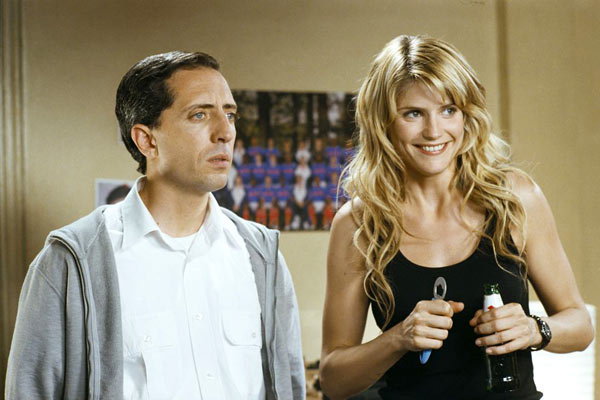
When a photographer publishes a shot of Levasseur arguing with Elena over whether or not he will indeed divorce his wife for her, Levasseur needs an excuse to avoid divorce with his wife, whose family owns 60% of his business. Levasseur’s attorney, Maître Fox (Richard Berry) decides there’s only one thing to do: find the random passerby in the photo and pretend that Elena is actually dating him. Soon, with an alacrity only possible in Hollywood – or, rather, French films mimicking the Hollywood model such as La Doublure – François Pignon, an unlucky-in-love valet at a nearby restaurant, is contacted and Elena moves into his apartment as the two attempt to fool the papa razzi – and Levasseur’s wife – that the two really are an item. Hilarity consequently ensues as the goofy Pignon (Gad Elmaleh) and the beautiful in an I-could-eat-Angelina-Jolie-for-Breakfast sort of way Elena shack up, Levasseur grows increasingly more jealous of their duo and Madame Levasseur continues to investigate the ostensibly odd situation. Danny Boon is uproariously pathetic as Pignon’s berating best friend and steals the screen in a scene of disbelief when he sees that a gorgeous supermodel is indeed co-inhabiting his friend’s apartment. And Virginie Ledoyen is cold yet likable as the object of Pignon’s affections. The film was a lesson in Product Placement 101 – the Mercedes should be listed on the cast list since the cars probably took up at least 50% of screen time, and Karl Lagerfeld makes a cameo to present his new season line, starring Elena – yet this big-budget Hollwoodian commercial French film actually provided a witty storyline and perfect performances from its talent. The film is directed by Francis Veber, who also directed two of my favorite French comedies of all time: Le Dîner de Cons (The Dinner Game) and Le Placard (The Closet). In the grand tradition of terrible Hollywood remakes of good foreign films, a remake of The Closet is currently in production over at Miramax, though I think it would be nearly impossible to find a better duo than Depardieu and Auteuil. La Doublure, which, in English means “the stand-in” but whose English title is The Valet, has been at the top of the French box office this week and deservedly so. I’ll do my best from now on to somehow end up in a papa razzi photograph (as if I haven’t spent my life in such a pursuit already) because who knows what male model a wealthy businesswoman might send to my doorstep?

ON VA S'AIMER

Last night, I went to a premiere of On Va S’Aimer, a new romantic comedy directed by Ivan Calbérac, at the Publicis Cinemas on the Champs-Elysées. In sum, I spent one hour and 26 minutes watching a bunch of French people cheat on each other and then sporadically break into song; really no different than a typical day in Paris … The film follows two couples, Laurent (Julian Boisselier) and Camille (Mélanie Doutey) and François (Gilles Lellouche) and Elodie (Alexandra Lamy). First Laurent and Elodie sleep together – and then sing about it through the streets of Paris in sort of a musical romantic comedy, if you will. Elodie then subsequently breaks up with François, leaving Laurent to decide between the forceful feminist Elodie and the sweet and charming Camille, all the while trying to prevent an angry François from discovering that he is Elodie’s mysterious new fling. Though ostensibly just another romantic comedy, the incredibly witty script and intermittent bouts of song and dance, distinguish this film from other more banal movies of its genre. While I’m not such a fan of Alexandra Lamy – nor her hairdo in the marriage scene, oh mon Dieu don’t they have fashion consultants on set? – the rest of the cast was superb, specifically Gilles Lellouche. The supporting cast also brought talent and laughs to the table, including a hilarious cameo by Patrick Chesnais as an undercover detective François hires to find out who Elodie’s new man of the hour is, and the always luminescent Anne Consigny. I watched the cast and crew shoot a scene from this film on the Pont des Arts last summer, so it was great to see it all come together so well. It reminded me of Chantal Akerman’s 1986 film Golden Eighties (Window Shopping), a glimpse of life in an underground mall where the characters cut hair, fall in and out of love, and sing about it. Long live the French musical comedy!

French Word of the Day
Undémodable : not ever going out of fashion

Quote of the Day
A Frenchman's home is where another man's wife is.

-Mark Twain

Pastry of the Day
La Madeleine


« Dating back to the 18th century in the French town of Commercy, in the region of Lorraine, the story goes that a girl name Madeleine made them for Stanislaw Lezczynski, Duke of Lorraine, who loved them and subsequently gave some to his daughter, Marie, the wife of Louis XV. Their popularity grew after that. »

Monday, March 27, 2006

Pardon my French...


From this weekend’s International Herald Tribune (“In English? Chirac won't hear of it” by Dan Bilefsky)
“A European Union summit meeting already overshadowed by concerns over economic nationalism turned into a linguistic battlefield when President Jacques Chirac of France, "deeply shocked" by the sight of a fellow Frenchman speaking English, stormed out of the room. Chirac defiantly admitted Friday that he had bolted from the meeting the night before because Ernest-Antoine Seillière, the French head of the European business lobby Unice, was using the language of Shakespeare rather than the language of Voltaire. When Seillière began addressing the EU's 25 leaders in English, Chirac interrupted him and asked why he was not using his mother tongue. "I'm going to speak in English because that is the language of business," Seillière replied. With that, Chirac, 73, stood up and left the room, flanked by his finance minister, Thierry Breton, and foreign minister, Philippe Douste-Blazy, officials present at the meeting said. "I was deeply shocked to see a Frenchman express himself at the council table in English, that's why we left - so as not to have to listen to that," Chirac said as the meeting ended Friday. Chirac, who studied in the United States and speaks English, said France had fought long and hard to promote the French language and to ensure it was spoken from the Olympics to the United Nations and the European Union. "It is not just national interest, it is in the interest of culture and the dialogue of cultures," he said Friday. "You cannot build the world of the future on just one language and, hence, one culture."

Chirac’s temper tantrum, while ostensibly puerile, manifests the ongoing battle between Gallic pride and the globalization of business and politics. The French have a reputation for being a proud people. From the Vikings to Charles de Gaulle’s franco-centric sentiments– “France cannot be France without greatness” – the French have traditionally considered themselves to be superior to the rest of the world. And, aren’t they? Their cuisine is arguably the best in the world (I challenge you to find me a better pastry on planet earth), their women are effortlessly and breathtakingly gorgeous, their capital city is a cultural Mecca, and their mother tongue is truly “the language of love.” Yet France’s cultural offerings have been threatened in recent years by a powerful globalization – bordering on Americanization – that seeks to unify international business, politics and culture. English-language menus are becoming more and more ubiquitous in Paris restaurants, Hollywood films continue to flood French cinemas, and English is becoming an obligatory course-requirements in schools all over the country. It has become nearly impossible to succeed in business without a general mastery of the English tongue. My job requires me to interact with film companies from all over the world and our common language is always English.
So was Chirac wrong to flee the scene when Seillière began speaking English? Or was Seillière betraying his fatherland by speaking in the language of Paris Hilton instead of the language of Paris, France? Both men raise convincing arguments. “I'm going to speak in English because that is the language of business,” said Seillière. He’s right, it is. Despite efforts to create a new, universal language called ????, English has become the lingo of the world. Even if we don’t necessarily agree with the monopoly of America’s arguably hegemonic culture, it’s a fact: English is the language of business, no matter what your longitude and latitude coordinates.
Chirac also has a point: “You cannot build the world of the future on just one language and, hence, one culture.” By first starting to speak the same language, will globalization eventually destroy the uniqueness of each culture? Yet how are we supposed to communicate with one another if we don’t speak the same language?

Chirac’s recent outburst is not the first time the French president has employed linguistic protectionism. When he met with President Bush last year, Chirac insisted on speaking French the whole time, forcing an interpreter to attend the dinner. At a UN meeting where translation services were not provided, Chirac allegedly pretended not to understand questions in English and demanded that Prime Minister Tony Blair act as his interpreter. Oh, the unmitigated Gaul of him!
I’ve very torn over this issue. On the one hand, I find it much easier to conduct business when clients speak English, and travel is also facilitated. However, one of the reasons that I came to Paris is because I absolutely adore the French language and culture and I hate to see such a beautiful language be replaced by our not-so-beautiful mother tongue. In the meantime, I leave you with a quote from fellow Francophile Mark Twain: “In Paris they just simply opened their eyes and stared when we spoke to them in French! We never did succeed in making those idiots understand their own language.”


Quote of the Day:
China is a big country, inhabited by many Chinese.
–the incredibly perceptive Charles de Gaulle

French idiom of the Day:

AH, LA VACHE!
Oh, the Cow! (Good God!)

French Dessert of the Day :
Clafoutis

« Clafoutis (pronounced kla-foo-TEE) is a French country dessert hailing from the Limousin region. Clafoutis comes from the word 'clafir' which means 'to fill'. Traditionally made with the first sweet cherries of the season and are left unpitted (kernels are said to add extra flavor while baking). An earthenware dish is buttered and then covered with a layer of stemmed cherries. A batter of eggs, flour, milk, and sugar (sometimes butter, flavorings, liqueur are also added) is then poured over the cherries. The consistency of the batter can be thin (like a pancake batter) to thick (cake-like). The assembled dish is then baked in the oven until the batter is puffed, set and nicely browned. Confectioner's (powdered or icing) sugar is sprinkled over the top and it can be served with vanilla ice cream or softly whipped cream. It is best served warm. » Clafoutis are traditionally made with cherries, but many different varieties are served all over France. My personal favorites include a plum clafoutis and an apricot clafoutis.

Monday, March 20, 2006

Dying Gauls

The Dying Gaul


"No one goes to the movies to have a bad time or to learn anything." (Jeffrey, in Craig Lucas' The Dying Gaul)

Yet, at a screening of the film, in competition at the first annual Paris Festival of Independent American Cinema, I both had a bad time and learned something. Patricia Clarkson, Campbell Scott and Peter Sarsgaard all deliver disturbingly sincere performances that contribute to an extremely depressing and uncomfortable mise-en-scène, but encourage deep philosophical thought and questioning of Hollywood's quotidian realities.

It was especially interesting - if not ironic - seeing the film following the success of Brokeback Mountain. In one of the incipient scenes, Jeffrey tells Robert: "Most Americans hate gay people... If they hear the movie is about gay people, they won't go." Oh really? I think the Academy would beg to differ.

In the film, a grief-stricken screenwriter (Sarsgaard) who has recently lost a lover, unknowingly enters a three-way relationship with a woman (Clarkson) and her film executive husband (Scott) - to chilling results. The film is not only a satiric look at the Hollywood studio system, but also a psychologically twisted penetration into the lives of its characters. This was not the best choice for a Friday night movie, but the performances are breathtaking, and the subject is very timely.


Les Aiguilles Rouges


Yesterday, I attended the closing ceremony of the American Independent Film Festival in Paris. Elsa Zylberstein ( famous French actress, you might recognize her from "Modigliani" opposite Andy Garcia), head of the jury, addressed the audience, saying: "It's a shame no one came to the screenings, I feel bad for the directors." She then left the theater before the next screening began.

Jean-François Davy's "Les Aiguilles Rouges" (English translation: "The Red Needles") takes place in September of 1960 and follows a group of young eagle scouts on a hiking trip in the Chamonix Valley. After getting into trouble at their summer camp, the boys, all between 12 and 16 years old, are sent off on a hike, led by Patrick, the oldest of the group. The eight boys all come from very different backgrounds, but are thrown together in the wilderness and must learn to get along. The film might be described as "Les Choristes go camping" (Les Choristes being, of course, Christophe Barratier's hit French film of 2005) and, like Les Choristes, was clichéd and cheesy at times, but also a very moving, well-acted film made with breathtaking cinematography of the French Alps region. Two of the boys who star in Les Aiguilles Rouges came to present the film which was an added bonus.

Quote of the Day:
"I grew up in Europe, where the history comes from."
-Eddie Izzard

Word of the Day:
Brokeback
(adj.) Used to describe anything of questionable masculinity.
Believed to have originated from the 2005 motion picture Brokeback Mountain."It's NOT a purse, it's a man-bag! It's very manly!"
"I don't know man, it looks kinda brokeback to me." -Boondocks

Pastry of the Day:
The Saint Honoré
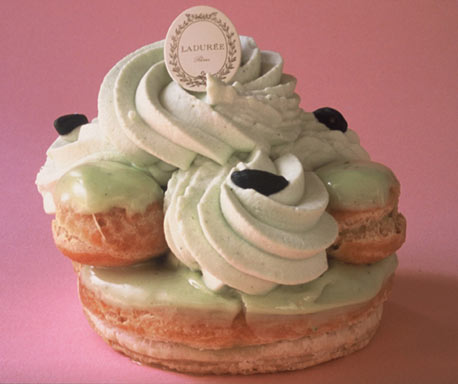
St Honorius was a bishop of Amiens in the sixth century and was the patron saint of pastry cooks. At some point further on in time they honoured him by creating the Gateau St Honoré, a pastry circle topped with a ring of choux buns and filled with whipped cream. Sometimes fruit is included and the whole thing finished with spun sugar. I adore the La Durée version (below). If you think it looks too good to devour or are on a - gasp! - diet, just tell yourself that you are participating in a religious sacrifice to the patron saint of pastry. Amen.

Saturday, March 18, 2006

Paris Pandemonium


Street protests? In Paris? Never! I mean I don’t know why Americans are so shocked by the recent activity in Paris – there is some kind of “manifestation” nearly every day in this country. You don’t think you’re paid enough? Riot! You feel discriminated against because of your religion/race/economic status? Storm the streets! You didn’t like the tie Jacques Chirac sported for his last press conference? Revolt! Your foie gras was too salty? Down with the government! Though the American media has, once again, exacerbated the situation here, the recent outrage and subsequent violence in central Paris worries me.
In fact, the last night’s violent protests – cars set fire, firebombs thrown, tear gas released by police – took place right down the street from where I live. I, fortunately, wasn’t directly affected, but seeing images of rioters right at the Place St Michel (which is literally a one-minute walk from my apartment) sent chills through my spine. As of today, more than 160 people have been arrested and at least 17 demonstrators and seven police officers injured.
Yet what is incredible to me is the response of France’s youth to the situation. Young people here really care what happens in government, whereas I think most American youth are for the most part, apathetic. Over 300,000-600,000 university and high school students took part in last Thursday's action and 1.5 million demonstrators have taken part in more than 150 rallies across the country.
I personally can’t imagine ever having stormed the streets of NY in High School for a law affecting labor contracts. Yet French youth are raised to believe that if they’re not happy, they have the right – and the obligation – to make some noise about it. Frankly, I should be out there protesting – the new law, if passed, will directly affect me. In case you all are confused by the hundreds of contradictory articles in the esoteric US press – NY Times, etc. – basically, all of the commotion is a response to the CPE, or Contrat Premier Embauche (First Employment Contract) which will allow employers to end job contracts for workers under the age of 26 at any time during a two-year probationary period without having to offer an explanation or give prior warning. So basically, for the next two and a half years – yes, I turned 23.5 last Monday, I am sure you all were celebrating in my honor from whatever cities you currently inhabit, thank you – I can just be fired for no apparent reason. Here, I’ve spent the last year and a half of my life jumping through fire and making deals with the devil (disguised as a 40 year old French woman heading up the DDTEFP in Nanterre) in order to have the right to work in this country, and, just days after I finally sign my contract, Villepin decides to chime in with this nonsensical new law.
Yet although this law affects me, I have not been storming the streets and setting fire to cars. However, I apparently look like I have. On Thursday, I was standing on the quai of the metro watching a group of young ruffians wearing “CPE” (Contrat Premier Embauche, the name of the new contracts Villepin is attempting to establish, which is the cause of such pandemonium) and yelling lots of French words that were rendered almost inaudible amid the cacophony, but that basically spelled out - and I translate in the kindest way possible – “Fuck Villepin and his new law.” I was then insulted by an ostensibly kind older couple who instructed me that the Place d’Italie was the other way on the metro line. I said “yes I know, so?” They responded “Oh you looked like you were heading to the protests.” So here I am, spending every waking – and sleeping, I do dream en français these days – minute trying to look like a sophisticated French woman, and these people take me for a rebellious student. Hélas…

Monday, March 13, 2006

IHT March 9, 2006


This just in: I have a letter printed in the International Herald Tribune.

http://www.iht.com/articles/2006/03/08/opinion/edlet.php#

The beauty of baseball, Anti-Semitism in France


THURSDAY, MARCH 9, 2006


Regarding the article "Enticing the world to game of lulls" by John Vinocur (Vantage Point, March 7): Robert Eenhoorn, the manager of the Netherlands' baseball team, got it right: Everyone has a place in baseball.

Perhaps this is why we still play baseball as adults (even though it's often as softball), while dropping other sports once we finish school.

Baseball is blessed because it's not controlled by time. In other sports, you wonder things like "can the team still pull it off with only two minutes left?" In baseball, however, you just have to ask yourself, "Can they do it?" because if they can, time will let them, it won't try to rein them in.

In our fast moving, time-conscious lives, baseball allows us to stop looking at our watches for an afternoon, whether we are on the field or sitting in the stands. That is the beauty of baseball.

Robert Dynan Mörfelden-Walldorf, Germany


Anti-Semitism in France

I am a 23-year-old American Jew living in Paris. Though the death of Ilan Halimi has indeed deepened my fears of anti-Semitic sentiment growing more ubiquitous in France ("Brutal killing stokes French fears," March 6) the response of both the Parisian Jewish community and the media has made me hopeful for change.

Signs outside of bookstores expressing sorrow for the death of "notre enfant" ("our child") are surrounded by candles, representing an expression of mourning from community members and passers-by.

After news of the murder was made public, candles were lighted in Jewish and non-Jewish homes all over the country and special ceremonies of mourning and protest of such hate crimes have been organized in towns throughout France. Many have invaded the streets of Paris to condemn the killings and the rise of anti-Semitism in France.

Halimi's death was unfortunate and unnerving - he was 23 years old, like me, and he did nothing to provoke such malicious violence. Who is to say that something similar won't happen to me or to one of my peers?

We must keep the dialogue going and continue to show solidarity, because, as Halimi's death proves, the barbarians are still among us and history continues to repeat itself in France.

Rebecca Leffler, Paris


Bush's India deal

It's no surprise that India gave President George W. Bush a fine reception ("Bush finds more respect in India than at home," by Elisabeth Bumiller, White House Letter, March 6).

Bush gave away the Nuclear Nonproliferation Treaty and, by his silence, the Muslims of Kashmir. He certainly seemed to give approval to the Indian objective of restoring New Delhi as the capital of the subcontinent.

In return, Bush appears to have gotten nothing. We can only hope (somewhat against the odds) that India (and China) will be smart enough to know that an Asia-wide military-political game will do little to solve the problems of the hundreds of millions of very poor citizens.

Philip D. Sherman, Singapore


Although the United States is the sole superpower, it cannot police the whole world. It needs to delegate responsibility to regional powers within a U.S. sphere of influence.

India has been a responsible nuclear nation, trading partner and an ally against terrorism. It has demonstrated multi-ethnic, democratic values over the years.

President George W. Bush should cement the new-found friendly relationship by securing Congressional approval of the nuclear agreement. The pact would go a long way in strengthening future ties between the United States and India.

Mandhata Chauhan, Northridge, California

Friday, March 10, 2006

Jean-Philippe


What if Michael Jackson had never become a hit pop star? Imagine what the world would be like if Madonna had remained a virgin? If Britney Spears was just a girl and not yet a famous woman? If Elvis Presley had never checked into Heartbreak Hotel? This is the premise behind the new French film, “Jean-Philippe.” I attended the press screening of the film on Wednesday night after a co-worker requested that I provide an “American perspective” of the film. He neglected to consider the fact that, although I was born and raised in Les Etats-Unis, I probably have a more extensive knowledge of French pop culture than the average Gallic native.
Before I describe the film, you’ll need some background knowledge. Johnny Hallyday is perhaps THE most famous French singer (and recently actor) in the collective history of France. Often referred to as the “Elvis Presley of France,” he has had a 40-year career in the music industry and is one of France's biggest stars. He has sold 80 million records, made 400 tours, had 18 platinum albums and performed in front of 15 million people. With the exception of those who may have chosen to live under a rock between the 1950s and the present, everyone in France knows who Johnny Hallyday is. To most, he’s simply known as “Johnny.”
The story: “Fabrice (Fabrice Lucchini) is Johnny Hallyday’s biggest fan. One day, he wakes up in a world where Johnny does not exist. In despair, he goes looking for Jean-Philippe Smet and finds him running a bowling alley in a Paris suburb. There, Fabrice tries to convince Jean-Philippe to ‘become’ Johnny.”
To be honest, I was expecting a one and a half hour advertisement for Johnny Hallyday and his music, but I was actually pleasantly surprised by how well-made the film is. Most of the – very French – humor comes from “inside jokes” requiring a basic knowledge of French pop culture; for example, the bowling alley where Jean-Philippe works is called l’Olympia, which is one of France’s largest concert venues. However, the concept of the film is exportable, and Fabric Lucchini’s performance is hysterical. I even laughed out loud a few times, a rarity, especially in screenings of commercial French comedies. Most of the humor, again, is very subtle and based on the singer’s real-life; Fabrice names his daughter Laura (after Laura Smet, Johnny Hallday’s real-life daughter with French actress Nathalie Baye), in one Karaoke scene, a pretty girl smiles at Johnny (the girl happens to be Laeticia, Johnny’s current real-life wife), and Benoît Poelvoorde (one of France’s famous actors) makes a cameo as a wanna-be rock star who is given advice to “give acting a go.” Hallyday proves himself as an actor, delivering an emotional, moving performance as a pop star whose dreams are shattered when a motorcycle accident prevents him from attending hit TV series “Top of the Pops” and consequently from being discovered by a talent agent.
Alas, it is unlikely that this film will make it across the Atlantic, but it should perform well at the French box office when it opens here in a few weeks. In fact, Johnny’s fans are ready to go; the phones here at Le Film Français haven’t stopped ringing as ladies from all over the country have been calling for copies of last week’s issues featuring an ad for the film on the cover. But alas, I must reply: Johnny has left the building.

Pastry of the Day :
La Religieuse
(Pronounced: lah / ruh lee zhugz)

An eclair-based dessert, this cake can take many forms. Originally called "la réligieuse" because it was said to resemble a nun in her habit, in miniature form it is made with a filled cream puff that is topped by a filled profiterole. It may also be made with as a pyramid of profiterole or made with elongated éclairs that have been formed into a pyramid and filled with creme Saint-Honoré. La Durée's version is absolutely divine, almost too pretty too eat. (I stress the ALMOST =)

Quote of the Day :
"Last week I stated that this woman was the ugliest woman I had ever seen. I have since been visited by her sister and now wish to withdraw that statement. "
-Mark Twain

Monday, March 06, 2006

The Hollywood Prom 2006


I’m going to say something right now that those of you who know me may find more shocking than two gay cowboys reading “In Cold Blood” in a burning car headed for the CBS studios to avenge the deaths of nine Israeli athletes. Are you sitting down? I, Rebecca Lynn Leffler, did not watch the Oscars last night. I know, next thing you know I’ll be telling you that I love chocolate and loathe tall, handsome men. But this travesty was no fault of my own, I must add. The telecast in France was limited to a midnight showing on Canal+, the “HBO of France” if you will, of which I, clearly not thinking ahead (or rather just trying to save 18 euros per month in cable fees) am not a subscriber. Thus, my transatlantic Oscar experience was limited to the five and a half hour e! Oscar pre-show. As if watching Isaac Mizrahi make a mockery of fashion on the red carpet or hearing Giuliana Depandi embarrasingly confess her love for George Clooney yet again wasn’t bad enough, I was forced to endure the broadcast in poorly translated French juxtaposed with the original English telecast, making for a cacophony of sounds that resembled Ozzy Osborne-speak and was barely comprehensible, but then again, who the hell cares because who really listens to what anyone is saying anyway, right? While the e! channel has been satiating my appetite for American popular culture abroad, their awards ceremony coverage is lacking both in language – why the dubbing? Contrary to popular belief, the French are indeed capable of reading subtitles – and substance – Ryan Seacrest has proven himself to be an idiot in any language.
However, I was pleased with the results of the Awards Ceremony itself. I’m thrilled that Crash won for best picture – it was a wonderful ensemble comedy that has unfortunately been overshadowed by the cowboy craze this season. An important film which deals with real issues without trying too hard to be political, Crash’s different storylines neatly come together to create a coherent, entertaining cinematic experience. I’m also quite pleased with Philip Seymour Hoffman’s win for Capote, not only because of our “moment” just a few weeks ago in Berlin, but also because he is one of America’s greatest contemporary actors and gave a perfect performance in a role ostensibly created just for him. I’m also happy about Reese Witherspoon winning for Walk the Line – she was able to shed her Legally Blonde image and become a very believable June Carter. What is it with this girl? Could her life be more perfect? She just won an Oscar, she’s officially the highest paid actress in Hollywood (she’s reportedly getting $29 million for her next film, more than Julia Roberts receives), she’s married to Ryan Philippe and has two of the most beautiful, angelic children I’ve ever seen, not to mention the fact that she’s a natural blond. In fact, I’ll take Ryan and the paycheck, you can have the rest dear. I’m glad Clooney won, mostly because he’s been overlooked at pretty much every other awards ceremony this season and has made cinema history by re-introducing political films to mainstream audiences. While he was terrific in Syriana (I had nightmares about the fingernail removing scene for weeks), I think Paul Giamatti’s performance in Cinderella Man has not been given nearly enough praise, not to mention that the film was pretty much forgotten this awards season though it remains, in my opinion, one of the top films of the year. Again, happy about Rachel Weisz’ win for The Constant Gardener, another one of my favorite films of the year. Though I’m not at all surprised that, in this, the year of the Gay Cowboy, Ang Lee walked away with the award for Best Director, though I must say I am disappointed. I think Munich was an incredible feat, and Spielberg’s work has gone virtually unrecognized this year both at the US box office and by the Academy. The fact that Eric Bana wasn’t nominated for Best Actor is outrageous. I’m pleased with Crash for Best Original Screenplay and Brokeback Mountain for Best Adapted Screenplay as well. And, bien sur, props to those crazy penguins for giving France something to celebrate as The March of the Penguins picked up Best Documentary.
As for the fashion, in sum, I think that Michelle Williams looked like she got attacked by a canary, Charlize Theron clearly forgot to change out of her Aeon Flux costume, Rachel Weisz was tastefully stunning, Jennifer Aniston looked sullen as usual in a boring black number, Diane Kruger, beautiful enough to have worn a paper bag and still have been stunning, was wearing my pick for favorite dress at the ceremony, Felicity Huffman was audacious, but still classy (unlike Teri Hatcher’s attempt to be 25 again at the SAG awards), Reese Witherspoon not only found her dress in Paris, but she actually bought it – yes, paid money for it and now owns it, what an unfamiliar concept in Hollywood these days – so I am, in turn, a fan, Kiera Knightley looked like a mermaid, a pretty mermaid, but still, I vaguely recall the Oscars being presented on land this year, Dolly Parton looked like – well, what really can I say here? I think the woman answers for herself, I loved Uma Thurman’s dress (and her performance in Prime by the way, which I just saw yesterday, what an underrated film), I thought Nicole Kidman looked a little stiff, but still divine, and Naomi Watts looked like she got attacked by King Kong’s less aggressive cousin on the way over, and I loved both Jessica Alba’s gold number and Salma Hayek’s striking teal dress.


Word of the Day: tar·ra·did·dle also tar·a·did·dle (tr-ddl)
n.
1. A petty falsehood; a fib.
2. Silly pretentious speech or writing; twaddle.


Quote of the Day: "The length of a film should be directly related to the endurance of the human bladder."
Alfred Hitchcock.

Pastry of the Day: Baba au Rhum

“According to many sources, Polish Prince Stanislas Leczinski, King Louis XV's father-in-law, introduced this cake while he was in exile and living in Nancy. Popular legend says that the Prince found the cake too dry and so he doused it with some of the rum he had been drinking. It was so good, he gave the command that he would only have his cake this way and he christened it Ali-Baba, in honor of his favorite hero from the Arabian Nights. The baba was introduced in Paris in the 1800's by a pastry cook, named Sthorer. He developed the practice of making his babas in advance and then brushing them with rum as they were sold. They quickly became the rage in Paris and Sthorer's fortune was made. He later developed the method of immersing the babas in a rum syrup.” The Baba au Rhum at Allard is particularly delicious, resembling a large French doughnut doused in rum – can you imagine anything more healthy?